
How to Have Courageous Conversations with Friends & Family
A guide for discussing Israel/Palestine at your dinner table
As we work to end the ongoing violence in Israel/Palestine, many of us have loved ones who don’t see the situation as we do. It is difficult to have conversations with those in our lives who hold views we find fundamentally incompatible with our own. While there is no one right way to have these conversations, this guide is here to help you feel prepared to open the dialogue. Most importantly, these conversations must come from empathy. You can win people over not by arguing, but with care.
Consider your goals
Setting out to change someone’s opinion rarely works, and bombarding people with facts can cause them to turn even further into their own beliefs. A more realistic goal for this kind of conversation could be exploring and hearing where you and your loved one are each coming from. Setting out to understand rather than convince is more likely to result in change.
Be Curious About Their Perspective
People listen when they feel listened to. Asking questions signals that you value the other person’s perspective and are genuinely interested in what they have to say. Questions also encourage individuals to think critically about their beliefs. A good place to start is: “How have you been feeling? What have you been afraid of? What are your hopes? What does peace look like to you? Who is included in that peace? What do their lives look like?”
Keep the Conversation Open and Flowing
As with any hard conversation, there are a few basic strategies you should keep in mind when talking to loved ones about Israel/Palestine:
Use “I” statements: Start statements with “I” to keep people from getting defensive. Focus on what you feel and believe, not what you think someone else believes.
Ask open-ended and small-detail questions: Yes/no questions can end a conversation, while open-ended questions give space to talk. Small-detail questions (who/what/when/where) can bring specifics back into the conversation.
Reflect back what you heard: Echo and restate what your companion has said, focusing on the topics, feelings and values they communicated, to show that you are listening and engaging.
Gently reframe: Validating people doesn’t mean leaving their views unchallenged. Challenge the opinion, not the person, and then try to reframe the topic using shared values.
Connect over shared values: Remember that our fight for equality, safety and peace for all is rooted in Jewish values: justice (tzedek) and the belief that all human life, created in the image of G-d, is sacred (b’tzelem elohim). Your loved one likely shares those values, and others like freedom, democracy and equality.
Model expressing feelings: If it’s true to your experience, admit that you, too, have had complicated or changing feelings about Israel/Palestine. This can make the conversation more balanced and create a safer space for coming to new conclusions.
Know when not to engage: Not everyone is open to having their mind changed, and sometimes pursuing a conversation will cause an irreparable rift. It’s okay to disengage or ask for a break in the conversation if the emotional or interpersonal stakes feel too high.
Ground Yourself in Reality
At a time when misinformation and fear-mongering are rife in the Jewish community, it can be helpful to remind yourself of a few truths and talking points before starting this conversation. That said, you DO NOT need to be an expert. It is okay to say you don’t have all the answers, but that you know the status quo (military occupation, bombing of Gaza, expanding settlements in the West Bank and support of Netanyahu’s fascist government) is NOT the answer.
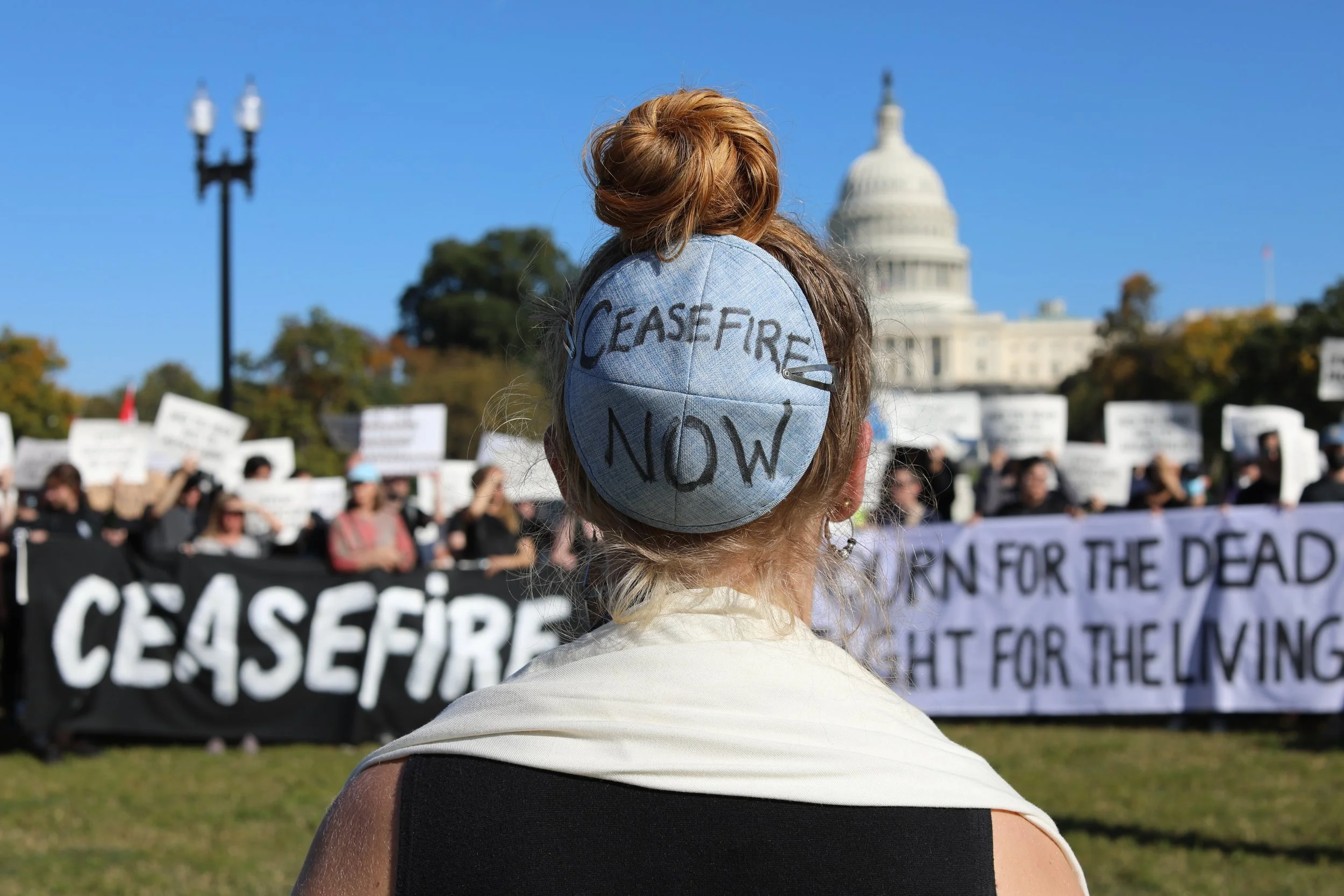
Ceasefire Now: Every life is a universe. Any deal that stops the bombs from falling and saves lives is a cause for relief and celebration. Likewise, the return of people long held captive is something families and communities have been desperately awaiting. Their reunions are moments of profound joy amidst so much grief. But a ceasefire, while urgently needed, is only a first step. True safety will come only when there is freedom and equality for all who live between the Jordan River and the Mediterranean Sea, Palestinians and Israelis alike. That requires a real political process, led by Palestinians and Israelis, that dismantles Israel’s system of apartheid and occupation, and invests in a shared future rooted in justice and self-determination.
Hamas: Many justify the murder of Palestinians in Gaza by proclaiming the goal of “destroying Hamas.” It’s important to emphasize the truth: it was horrifying and heartbreaking to see Israelis violently murdered on October 7, and none of us want that to happen again. We all want better leadership for both Palestinians and Israelis. And destroying people’s homes and killing their loved ones, many of them children, will only drive more support for violence and extremism against the country doing the bombing. We know, from many examples across history, that more violence leads to more radicalization. Moreover, Israeli leaders have made clear that their priority is the maximum destruction of Gaza, not just destroying Hamas.
Genocide: Amnesty International, the International Court of Justice, B’Tselem and leading genocide scholars, including many Israeli genocide scholars, have all used the term to describe what is happening to Palestinians in Gaza, and they can’t be easily dismissed or disparaged as antisemitic or pro-Hamas. We know that the word “genocide” may be hard for many people to hear, and may invoke trauma or other difficult reactions. That’s understandable. If you suspect that focusing on the word genocide might get in the way of having a productive conversation, focus instead on describing the specific acts (such as indiscriminate killing, restriction of food, widespread displacement of civilians and examples of the Israeli government’s genocidal rhetoric).
Rising Antisemitism: Antisemitism is a huge problem, and we know it’s getting worse both here in the US and around the world. We oppose antisemitism everywhere, and we must work to dismantle it, just as we work to dismantle Islamophobia and racism. It makes sense that our community is afraid. We also know that calls for Palestinian liberation are not antisemitic. In fact, they are rooted in our Jewish values of tikkun olam (repairing the world) and pikuach nefesh (saving a life). Concerns about antisemitism are concerns about the safety of Jewish communities, and we know that the safety and liberation of Jews and Palestinians are deeply entwined. We also know that the only true safety is shared safety.
“From the River to the Sea”: Many in our community feel scared when they hear this slogan. We know that to us it is intended as a call for freedom and equality for all peoples in the land between the Jordan River and the Mediterranean Sea. If it’s a phrase you’ve used, explain what you mean when you say this phrase, regardless of what fringe elements on either side claim it means.